Last Updated on June 14, 2015 by Nancie
Barqash Camel Market, Egypt 2004…

Fast forward to today, and I am sitting at my computer in Korea Googling “camel urine” + mers. I hold my breath, and am gobsmacked when I see 87,500 hits, and the top hit is from WHO (World Health Organization). It seems I am onto the reason why the Korean government is warning people not to drink camel urine (those photos in a moment).
Here is what the WHO is saying about camels and their pee…
[box] What is the source of the MERS virus—bats, camels, domestic animals? The source of the MERS-CoV is not yet fully clear. A coronavirus very similar to the one found in humans has been isolated from camels in Egypt, Oman, Qatar, and Saudi Arabia. . It is possible that other reservoirs exist. However, other animals, including goats, cows, sheep, water buffalo, swine, and wild birds, have been tested for MERS‐CoV, but so far none have been found in these animals. These studies combined support the premise that dromedary camels are a likely source of infection in humans. Should people avoid contact with camels or camel products?
Is it safe to visit farms, markets, or camel fairs? In countries in the Middle East affected by MERS-CoV, as a general precaution, anyone visiting farms, markets, barns, or other places where animals are present should practice general hygiene measures, including regular hand washing before and after touching animals, and avoid contact with sick animals. The consumption of raw or undercooked animal products, including milk and meat, carries a high risk of infection from a variety of organisms that might cause disease in humans. Animal products processed appropriately through cooking or pasteurization are safe for consumption, but should also be handled with care to avoid cross‐contamination with uncooked foods. Camel meat and camel milk are nutritious products that can continue to be consumed after pasteurization, cooking, or other heat treatments. Until more is understood about MERS, people with diabetes, renal failure, chronic lung disease, and immunocompromised persons are considered to be at high risk of severe disease from MERS‐CoV infection. Especially in the Middle East people should avoid contact with camels, consuming raw camel milk or camel urine, as well as eating meat that has not been properly cooked. Camel farm and slaughterhouse workers in the affected areas should practice good personal hygiene, including frequent hand washing after touching animals, facial protection where feasible, and the wearing of protective clothing, which should be removed after work and washed daily. Workers should also avoid exposing family members to soiled work clothing, shoes, or other items that may have come into contact with camels or camel excretions. Sick animals should never be slaughtered for consumption. People should avoid direct contact with any animal that has been confirmed positive for MERS‐CoV.Content goes here[/box]
Why have the Koreans decided it’s important to highlight the camel urine (among other things). It’s not like we have camels roaming anywhere free. I think there might be a couple in the Daejeon Zoo, and maybe the zoo in Seoul. Somebody did mention to me that the posters on the subway and in the buses come from the WHO. That could be true, and if so, explains the inclusion of the camels.
You can read about MERS on the WHO site. I think this is your best source for educating yourself about the virus.
MERS Poster on the Subway…

Slightly different MERS poster on the public buses…
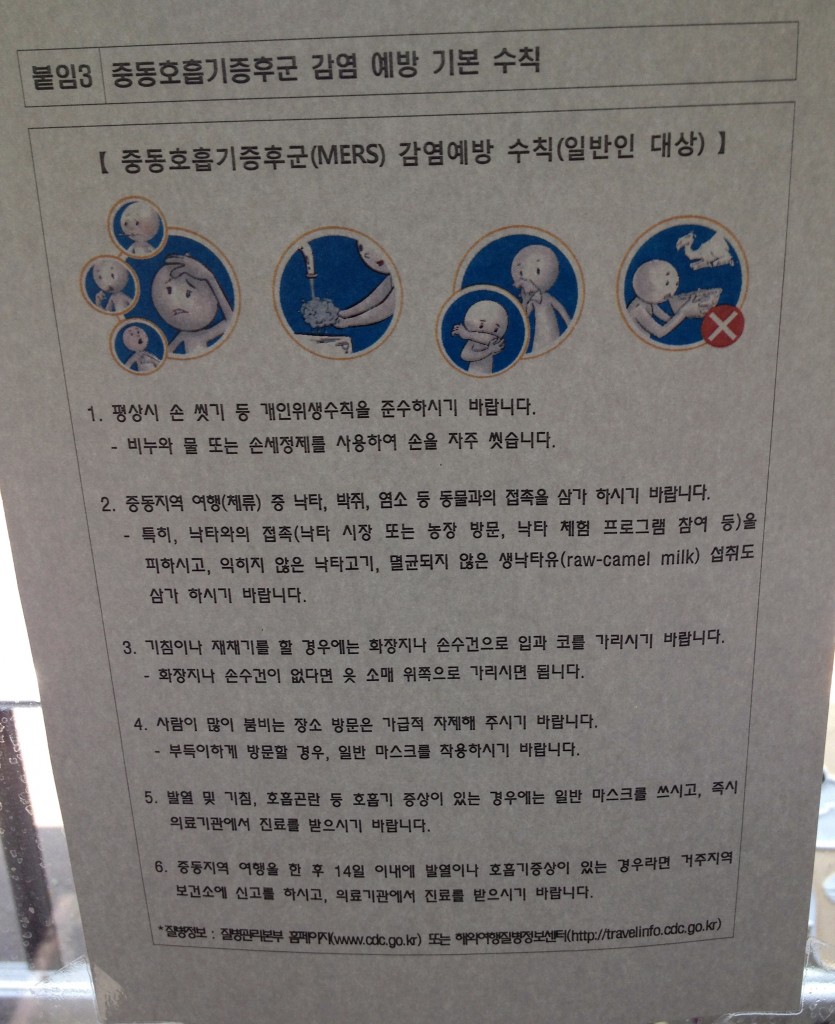
What does this mean for anyone thinking about traveling to Korea? Should you, or shouldn’t you? That’s up to you. All cases to date have been as a result of people visiting hospitals and coming in contact with patients infected with MERS, or people who have come in contact with the MERS patients (family members, friend, health care workers). The government has FINALLY released a list of the hospitals that have been exposed to the virus. I think this has made a lot of people rest easier. Obviously, you don’t want to visit any of those hospitals while you are on the ROK. There is also a MERS hotline this is supposed to be our source for the most up to date news regarding the virus.
If you do decide to travel in Korea this summer (and I hope you do) be sure to follow all the WHO guidelines regarding hygiene.
Also it’s important to keep in mind that some Korean hygiene practices may be a little different for what we’re used to in the West.
Public Washrooms
- Most public washrooms do not provide hot water, cold only. I personally carry a bottle of sanitizer that I use after I wash. I have no idea if this helps or not, but it makes me feel better.
- Soap can be an issue. Always carry your own.
- No guarantee that there will be anything to dry your hands with. If this bothers you, carry a towel.
- Most washrooms will have toilet paper, but always good to carry an emergency supply.
- Disinfected wipes are also a good thing to have in your bag.
Public Places/Government Buildings
- Korea is a crowded place, and people here often don’t cover their mouths when they cough and sneeze. To be on the safe side, I wear a mask when I’m on the bus, subway, or in any crowded area. Many people are wearing mask, but many are not.
- Be aware of the infected hospitals and stay away from them.
- Temperature checks are taking place at the entrances of many government buildings.
Eating in Restaurants and public places
- Be aware that Koreans practice a communal style of eating, and often eat out of the same cooking pot. Take care to use your own spoon to take a portion from the pot onto your own plate. Don’t eat out of the pot with your chop sticks.
- Don’t share the same drinking glass with anyone else (not totally uncommon here).
- Street vendors are popular here. Lately, I have been staying away. The food is good, but I do have hygiene concerns. Better safe than sorry.
- As a precaution, I am staying away from buffet restaurants.
- In coffee shops I am asking for my coffee in a paper takeaway cup ( Probably not necessary, but just one more precaution that makes me feel safer).
Personally, if I was planning a trip here, I probably wouldn’t cancel. However, I would be taking every precaution to keep myself healthy, and practice all of the safety measures recommended by WHO. I would also be keeping up-to-date on the situation through the official hotline and responsible media outlets.
And I’d also be on the lookout for those pesky liquid sugar bottles posing as hand sanitizer! 🙂 Facebook friends know what I mean!

I hope this information gives you some insight into MERS and Korea. If you have other questions about MERS in Korea send me a message, or leave a comment below.
Safe travels on the ROK this summer!
8 responses to “Korea and MERS: What Travelers Need to Know”
Great idea to post these tips, Nancie. They’re pretty straightforward and common sense. But camel urine? I’d never heard of that one.
The way the world is these days, we really can’t be too careful.
Hi Marcia. Thanks, and yes they are common sense. Unfortunately, Koreans don’t always display the best common sense when it comes to hygiene (particularly the older generation. It’s not all that uncommon to have someone cough or sneeze and not cover their mouth.
Thanks for the update! My daughter’s classes were cancelled due to the outbreak and I have been very worried. But she assures me that things are not as bleak as the media has portrayed it.
Hi Jill. Yes, the media does tend to blow things out of proportion. It also took the government way to long to provide the information that people needed to know what is happening.
Great post, Nancie. Informative and entertaining!!
Hi Jackie…Thank you!
I’ve been wondering what precautions people have been taking in the ROK. When the Ebola scare was going around the USA, people were getting quite crazy for a few weeks even though the number of infected was quite low. With all the highlighted info about camel urine, I thought perhaps it was in one of those strange Asian potions like rhino horn. Back in Malaysia, the doctor thought that I had Leptospirosis which is transmitted via rat urine. My kids wondered why I would drink rat urine. It turns out that people accidentally expose themselves to it by not cleaning off the tops of soda cans before drinking. Yuck! As it turned out, I had Chikungunya which is transmitted by mosquitoes. Stay healthy!
Hi Michele. That must have been worrying for you. It’s so easy to pick up a bug/virus these days. You just never know where or when. All government buildings like train stations, bus stations, etc. are now screening people as they enter. Even my uni. was screening students as they went in to the main building last week.